How the C.A.K.E. Connection Saved My Daily Life (and How It Can Transform Yours)

It was 6:15 PM on a Tuesday, and my kitchen was rapidly turning into a disaster zone.
I was attempting a “1-hour healthy meal” recipe, but in my desperate bid to rush dinner onto the table, I completely threw the instructions out the window. Within minutes, the pan scorched, the food burned, and thick smoke began billing across the ceiling. I ended up frantically throwing open the doors, waving a dish towel to stop the fire alarm from screaming at the whole neighbourhood.
Smelling the smoke, my two amazing children came down to see if they could help me. As they tried to lend a hand, they started telling me about everything happening at school tomorrow—and casually dropped that they needed my help preparing for project submissions due in the morning.
I was doing my absolute best to listen carefully, nodding along while my brain was silently hyperventilating. Burned dinner. Smoky kitchen. Tomorrow’s school submissions. And then—the sudden, sickening jolt—I remembered a critical work deadline I had completely forgotten.
And right on cue, the front door clicked open. My loving husband walked in early to surprise me, beaming with a huge smile.
There I was, in a room surrounded by the three people I love most in the entire world. But my response to them in that moment? It did not illustrate the deep, unconditional love I have for them. Not even close.
All of a sudden, my words were harsh and short. I found fault with everything—the smoke, the sudden surprises, the timing, the chaos. In that brief, overwhelming second, it felt as though my world had come to an end.
I felt immediate shame afterward. I had tried so many strategies over the years to stop these knee-jerk emotional reactions, but nothing seemed to break the vicious cycle long-term.
Until I stumbled upon a life-changing concept.
The Breakthrough: Diagnosing the “Switch”
I was watching an episode of The Deep End podcast with Taylor Welch, where he was interviewing Dr. Marcus Warner. In the interview, Dr. Warner introduced a simple, brilliant diagnostic tool centred around relational skills—what he calls making relational connection a “piece of C.A.K.E.”
Dr. Warner explained that human beings have an internal “relational switch” in the brain. He shared a simple four-point assessment to immediately diagnose whether your switch is flipped OFF:
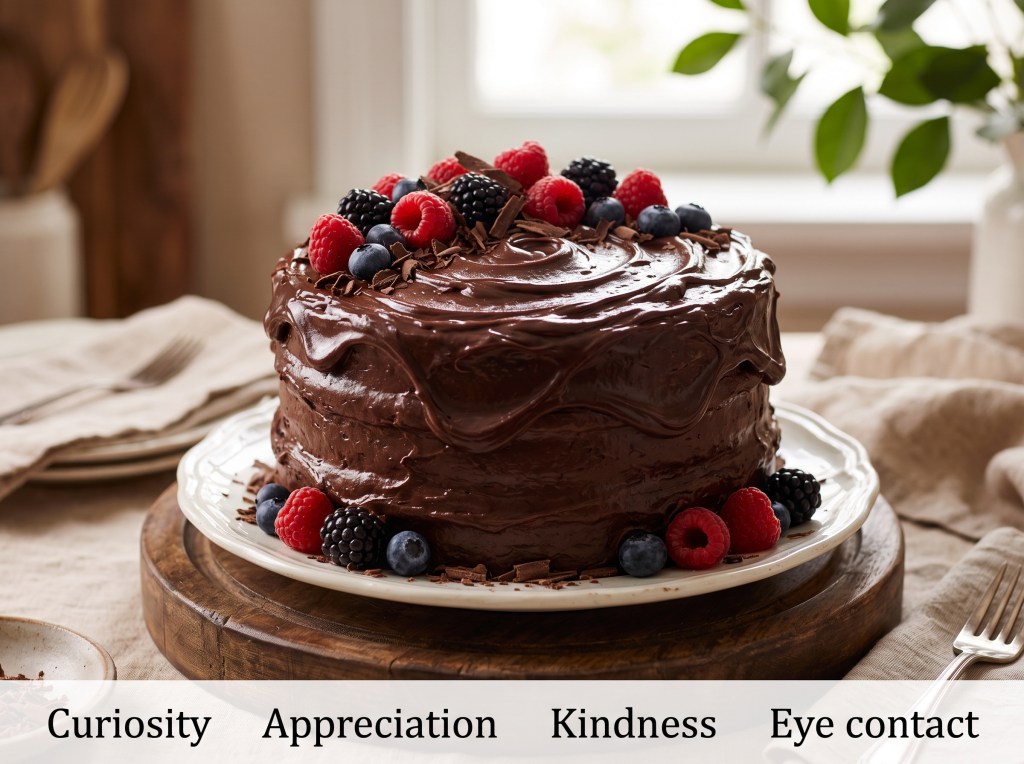
- C – Loss of Curiosity: You’ve lost all curiosity about the other person. If you’re not curious, it means you think you have them all figured out. And because you think you have them figured out, you aren’t really listening—you’re just waiting for them to stop talking so you can jump in.
- A – Loss of Appreciation: Even with someone you normally love and appreciate, when your switch is off, you literally cannot think of a single thing you appreciate about them in that moment.
- K – Loss of Kindness: You are normally a kind person, but right now you can’t even remember what it looks like to be kind. You just want them to stop whatever they are doing.
- E – Loss of Eye Contact: When your switch is on, eye contact is easy and natural. When it’s off, you are either looking everywhere but at them, or you are staring them down in order to win.
When I heard this, a giant lightbulb turned ON. Looking back at those painful times in my kitchen—and every other time I had snapped at my family—my switch had been completely OFF. And when your switch is off, not one good word comes out of your mouth.
Today, I use C.A.K.E. as a quick personal diagnostic: “Is my switch off right now?”
Once you realize your switch is OFF, you can use the neuroscience behind each step to flip it back ON.
The Science of C.A.K.E. & How to Flip Your Switch Back ON
When your relational switch flips OFF, your brain’s amygdala (the threat detector) has hijacked your system. It sends you straight into fight-or-flight mode, shutting down your prefrontal cortex—the executive centre responsible for empathy, logic, and connection.
Here is what is happening scientifically at each step of C.A.K.E., along with the exact neuro-hacks to flip your switch back ON:
1. C – Curiosity: Shift from Defence to Wonder
The Science: Threat-based judgment and genuine curiosity physically cannot occupy the brain at the exact same time. Curiosity activates the brain’s seeking and reward pathways, signalling safety to the autonomic nervous system and bringing your prefrontal cortex back online.
How to Switch it ON:
The Micro-Action: Ask yourself one silent “wonder” question. “I wonder what kind of day they had?” or “I wonder why my nervous system feels so overwhelmed right now?” Shifting from “I already know what they’re doing wrong” to “I wonder what is beneath this?” instantly disarms the threat response.
2. A – Appreciation: Flip the Switch with Gratitude
The Science: The human brain has a “negativity bias”—it scans for danger and defects first. Actively choosing appreciation stimulates the release of dopamine and oxytocin, the neurochemicals that lower stress hormones (cortisol) and rebuild trust.
How to Switch it ON:
The Micro-Action: Find one small, undeniable truth to appreciate in that exact second. Even if it’s simply: “I am thankful my husband came home safe,” or “I am grateful my children came in to help me.” Gratitude acts as an immediate chemical toggle back to warmth.
3. K – Kindness: Lower the Volume, Soften the Tone
The Science: Humans possess specialized mirror neurons that automatically copy the vocal acoustics, body language, and emotional state of those around us. When you raise your voice or sharpen your tone, the other person’s nervous system instinctively matches your aggression to protect itself.
How to Switch it ON:
The Micro-Action: Intentionally drop your vocal volume by 20% and slow down your speaking cadence. Take a slow exhale before responding. Lowering your tone serves as a physiological signal of co-regulation—calming both your nervous system and theirs.
4. E – Eye Contact: Signal Safety & Presence
The Science: Gentle, steady eye contact activates the ventral vagal complex (the part of the nervous system responsible for social engagement and emotional safety). Avoiding eye contact or staring someone down with an intense glare signals hostility or threat to the mammalian brain.
How to Switch it ON:
The Micro-Action: Soften your gaze. Unclench your jaw, look directly into their eyes for 3 to 5 seconds, and let your face communicate: “You are safe with me.”
Navigating the “Switch Clash”: When One (or Both) of You is OFF
Understanding your own switch is life-changing—but what happens when two people in the same house collide?
Dr. Warner shared a story from early in his marriage. He admitted that after discovering the “switch concept,” he had a moment where he completely shut down during a disagreement. He was sitting on the couch, refusing to talk, avoiding all eye contact—his relational switch was totally OFF.
Normally, his wife would have poked, prodded, and pushed until he snapped, leading to a massive explosion. But this time was different. Her switch was ON.
Because her switch was on, she did something remarkable. She walked over to the couch and asked softly:
“Is it OK if I come and sit next to you?”
Dr. Warner was so shut down he could barely speak; he just shrugged his shoulders. She sat down next to him. Then she gently asked:
“Is it OK if I hold your hand?”
Dr. Warner looked at her, pulled away slightly, and thought to himself: You are not very good at this fighting stuff, are you? But he replied, “Fine, you can hold my hand.”
What happened next was increasable: Dr. Warner recalled that the moment she took his hand, he felt something literally melt inside. It was like he could hear an audible POP inside his brain as his switch flipped back on! Suddenly, his curiosity returned, he felt immense appreciation for her, he wanted to be kind, and they were able to have a calm, normal conversation.
The Two Rules for Clashing Switches:
Rule #1: If BOTH Switches are OFF… Take a Timeout!
If your switch is OFF and your spouse’s switch is OFF, do not try to work it out in that moment. You might as well go to separate rooms! When both switches are off, any attempt to talk will only lead to defensive blows and hurt feelings. Step away, take a time out, recalibrate your own nervous system, and come back together only when at least one of you has flipped your switch back ON.
Rule #2: If YOUR Switch is ON and THEIR Switch is OFF… Use the Oxytocin Shortcut!
When your partner is shut down, stop poking them with logic or demanding that they talk. Instead, leverage the power of Oxytocin—the body’s natural “connection and bonding hormone.”
Oxytocin acts as a physiological circuit-breaker. Safe physical proximity and gentle, non-demanding touch (like holding a hand, placing a arm on a shoulder, or sitting side-by-side) trigger an immediate flood of oxytocin in the brain. This hormone rapidly dampens the amygdala’s threat response, lowers cortisol levels, and produces that exact “melting” sensation. It gives your partner’s nervous system the biological green light it needs to flip their switch back ON.
Bringing C.A.K.E. into Parenting
This exact same dynamic applies to parenting!
When children are being at their most difficult—whether having a toddler meltdown or giving you the silent treatment—it is usually because their relational switch has flipped completely OFF.
When parents realize this, parenting gets infinitely easier:
- Stop trying to reason with an OFF switch: When your child’s switch is off, lecturing them or shouting only pushes their switch further into self-defence.
- Be the anchor (Keep YOUR switch ON): If your child’s switch is off, but your switch stays on, you can help co-regulate their nervous system.
- Use gentle proximity & Oxytocin: Sit beside them on the floor. Lower your voice. Offer a gentle hand or a warm hug: “Is it okay if I sit next to you while you feel upset?”
Teaching children how to recognize when their switch is off—and helping them regulate it back on through safe connection—builds emotional intelligence that lasts a lifetime. The earlier in life children learn these core relational skills, the smoother and more connected your relationship will be when they reach the teenage years!
Serving Up C.A.K.E. Today
The next time you find yourself standing in the middle of a smoky kitchen—or a tense conversation—pause for three seconds. Check your diagnostic: Is my switch OFF?
- Curiosity over assuming you have them figured out.
- Appreciation over fault-finding.
- Kindness over wanting them to just stop.
- Eye contact that connects instead of glaring or avoiding.
If your switch is off, take a breath and flip it on. And if your spouse or child is the one shut down, don’t force a fight—offer a soft word, a gentle hand, and let oxytocin do the heavy lifting.
References
Warner, M., & Coursey, C. (2018). The 4 Habits of Joy-Filled Marriages: How 15 Minutes a Day Can Change Your Relationship. Moody Publishers. (Explores the relational brain switch concept and practical daily habits for couples).
Warner, M., & Wilder, E. J. (2016). Rare Leadership: 4 Uncommon Habits for Increasing Trust, Joy, and Engagement in the Workplace. Moody Publishers. (Introduces the neuroscience of the relational switch and brain-based coaching tools).
Hansen, B. (2023). Life is Hard, God is Good, Let’s Dance. Thomas Nelson. (Discusses relational presence and the practical C.A.K.E. framework).
Iacoboni, M. (2009). Mirroring People: The Science of Empathy and How We Connect with Others. Picador. (Research on mirror neurons, vocal tone co-regulation, and non-verbal empathy).
Porges, S. W. (2011). The Polyvagal Theory: Neurophysiological Foundations of Emotions, Attachment, Communication, and Self-regulation. W. W. Norton & Company. (Establishes the role of the ventral vagal system, eye contact, and vocal acoustics in signaling relational safety).
Siegel, D. J. (2012). The Developing Mind: How Relationships and the Brain Interact to Shape Who We Are (2nd ed.). Guilford Press. (Detailing the amygdala response vs. prefrontal cortex integration during emotional distress).
Zak, P. J. (2012). The Moral Molecule: How Trust Works. Dutton. (Explores the neurobiology of oxytocin, physical touch, and lowering stress hormones in social bonds).

