
Have you ever stopped to wonder why almost every song playing on the radio, streaming services, or television is tuned to the exact same pitch?
Most listeners assume that standard concert pitch—where the central note A above middle C is tuned to 440 Hertz (Hz)—was selected because it represents the natural pinnacle of musical harmony or human acoustic preference.
The reality is far more pragmatic. Standard 440 Hz tuning was not chosen by acoustic scientists, neurobiologists, or wellness experts. It was an industrial compromise engineered for radio broadcasting, factory efficiency, and global trade.
As modern neuroscience and psychoacoustics dig deeper into how sound frequencies interact with the human autonomic nervous system, a compelling question emerges: Does 440 Hz serve our physiological well-being, or is it simply a relic of mid-20th-century broadcast engineering?
Here is the history behind the 1939 pitch standardization, what modern scientific studies reveal about standard tuning, and why shifting your acoustic reference to 444 Hz offers a mathematically precise bridge to deeper calm, focus, and restorative peace.
The 1939 London Summit: Engineering Over Human Well-Being
Before the 20th century, musical pitch was fluid, contextual, and deeply varied across geographic regions:
The Baroque Era (1600–1750): Pitch routinely fluctuated between 415 Hz and 430 Hz, giving instruments a warm, resonant, and mellow timbre.
19th-Century France: In 1859, the French government passed a law establishing Diapason Normal at 435 Hz to prevent orchestras from continuously raising their pitch to achieve brighter sound at the expense of vocalists’ vocal cords.
Late 19th-Century Britain: British military and brass bands tuned much higher—often around 452.5 Hz—to produce maximum brilliance and loudness outdoors.
This pitch anarchy posed a severe financial and logistical challenge for two booming 20th-century industries: mass instrument manufacturing and international radio broadcasting. Pianos built in London could sound noticeably out of tune when playing alongside live radio broadcasts originating from Paris or Berlin.
The London Conference of May 1939
In May 1939, an international conference of broadcast engineers, acoustic delegates, and industrial standards representatives convened at Broadcasting House in London under the auspices of the International Federation of the National Standardizing Associations (ISA, the predecessor to ISO).
The primary stakeholders driving the meeting were major broadcasting corporations—including the British Broadcasting Corporation (BBC)—and piano manufacturers. They needed a single, universally repeatable frequency standard that could withstand temperature variations in broadcasting studios and streamline international instrument sales.
Despite objections from prominent French and Italian musicians who favoured lower, more vocal-friendly tunings (such as 432 Hz or 435 Hz), the committee officially adopted A4=440Hz. This standard was later formalized by the International Organization for Standardization as ISO 16.
The Key Takeaway: The universal standard of 440 Hz was established to solve industrial logistics and radio transmission friction. Human biology, heart rate variability, and emotional wellness were never part of the equation.
What Modern Research Reveals About 440 Hz
While 440 Hz solved industrial challenges, modern physiological and endocrine research suggests that standard pitch places subtle, continuous tension on the human nervous system compared to biologically resonant alternatives.
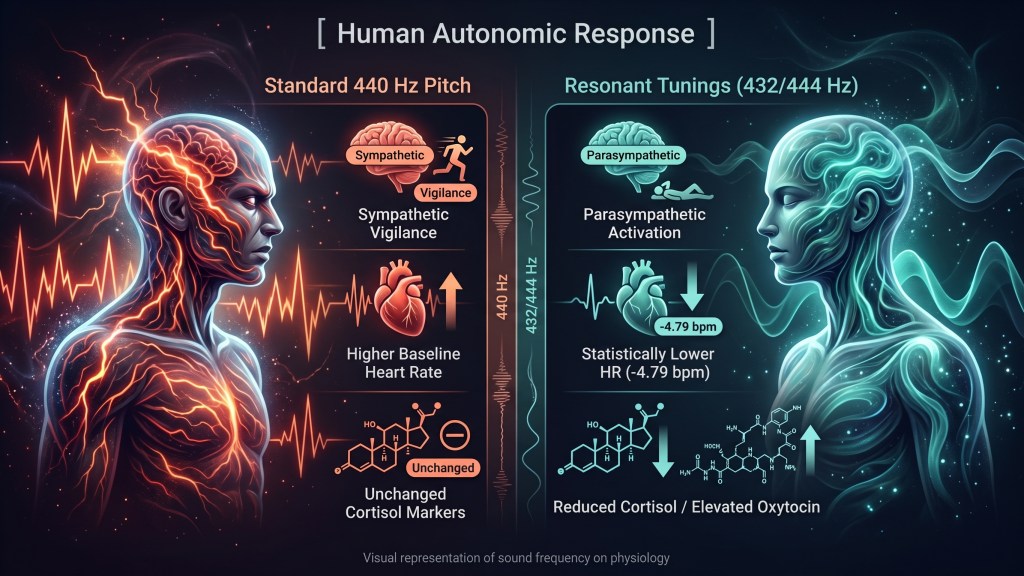
Elevated Physiological Arousal
In a landmark double-blind cross-over pilot study published in Explore, researchers Calamassi and Pomponi (2019) measured vital physiological parameters in subjects listening to the exact same music tuned to standard 440 Hz versus alternative harmonic tuning.
The findings were striking:
- Heart Rate Modulation: Listening to alternative resonant music resulted in a statistically significant decrease in heart rate, compared to 440 Hz.
- Respiratory Tension: Participants listening to 440 Hz maintained higher baseline respiratory rates and blood pressure, signaling sustained sympathetic nervous system activation (the “fight-or-flight” axis).
- Subjective Fatigue & Focus: Participants reported higher levels of mental focus, overall satisfaction, and lower physical strain after listening to lower, harmonically aligned frequencies compared to standard 440 Hz audio.
Stress Hormones vs. Bonding Hormones
In 2018, Dr. K. Akimoto and colleagues conducted a controlled clinical trial examining the endocrine effects of sound frequencies on human saliva markers.
The study compared standard 440 Hz sound environments against frequencies aligned with 528 Hz:
- Cortisol Reduction: Exposure to 528-Hz-aligned sound triggered a statistically significant drop in salivary cortisol (the primary human stress hormone) within just 5 minutes.
- Oxytocin Boost: The same resonant exposure caused a marked increase in salivary oxytocin (the neurohormone associated with empathy, trust, and social bonding).
- 440 Hz Control: Standard 440 Hz music produced no significant reduction in cortisol and no measurable surge in oxytocin.
When we listen to hours of standard 440 Hz music through modern noise-isolating headphones, our auditory processing system must constantly adapt to acoustic friction that sits subtly out of step with natural biological frequencies.
The Mathematics of 444 Hz: Reclaiming Intentional Sound
If standard 440 Hz keeps the body in subtle vigilance, why is 444 Hz the ideal tuning shift for modern musicians, producers, and intentional listeners?
The answer lies in simple, elegant acoustics: Tuning A4 to 444 Hz mathematically unlocks 528 Hz within standard instrument key scales.
The 12-Tone Equal Temperament Math
Modern Western music relies on 12-Tone Equal Temperament (12-TET), dividing the octave into 12 equal semitones. The mathematical formula to find the frequency of any note based on a reference pitch A4 is:

Where 
In the key signature of C, the note C5 sits 3 semitones above the concert pitch A4.
At Standard 440 Hz Tuning:

At 444 Hz Tuning:

By shifting concert pitch upward by just 4 Hertz—from 440 Hz to 444 Hz—the note C5 aligns precisely to 528.01 Hz.
[ A4 Reference Pitch: 440 Hz ] ──(+3 Semitones)──> C5 = 523.25 Hz (Standard Industrial)
[ A4 Reference Pitch: 444 Hz ] ──(+3 Semitones)──> C5 = 528.01 Hz (Bio-Harmonic Resonance)
Why the 528 Hz Connection Matters
528 Hz is historically celebrated across acoustic traditions and contemporary sound therapy as a core Solfeggio frequency associated with:
- Parasympathetic Activation: Soothing autonomic nervous system arousal to lower heart rate and reduce physiological strain.
- Cellular & Endocrine Balance: Promoting significant cortisol reduction while encouraging calm, focused attention.
- Clarity Without Loss of Brilliance: Unlike 432 Hz—which can sometimes make modern digital synths or acoustic instruments sound slightly dull or muddy—444 Hz retains bright modern presence while replacing artificial tension with restorative resonance.
Sound as Intentional Practice
Music is not merely digital content or background noise; it is physical vibrational energy interacting directly with your central nervous system, cellular chemistry, and brainwave activity.
When we choose to produce or consume music tuned to 444 Hz, we move past the arbitrary broadcast standards of 1939 and restore intentionality to our soundscape.
How to Implement 444 Hz in Your Daily Life
- For Music Producers & Creators: In your Digital Audio Workstation (DAW)—whether Logic Pro, Ableton, or Cubase—adjust your virtual instrument master tuning setting from 440.0 Hz to 444.0 Hz. String instruments and acoustic guitars can be retuned directly using any standard digital chromatic tuner.
- For Listeners & Devotional Practice: Seek out tracks specifically recorded or retuned to 444 Hz / 528 Hz. Notice how your body responds over a 20-minute listening session compared to standard radio audio.
To easily bring the calming physiological benefits of resonant sound into your daily routine, explore the specially crafted 444 Hz tracks from Ahava_1412
Listen on Youtube
Listen on Spotify
Conclusion: An Invitation to Listen Differently
The 1939 London conference gave the industrial world convenience, uniform manufacturing, and broadcast efficiency. But as creators and conscious listeners in an era defined by high noise and chronic stress, we are not obligated to limit our soundscapes to mid-century engineering standards.
Tuning to 444 Hz is more than an acoustic curiosity—it is a conscious choice to align modern musical expression with human biology, peace, and restorative presence.
Have You Experienced the Shift?
Have you noticed a physical or emotional difference when listening to music recorded outside standard 440 Hz tuning? Share your thoughts, questions, and experiences in the comments below!
References & Further Scientific Reading
- Calamassi, D., & Pomponi, G. P. (2019). Music tuned to 440 Hz versus 432 Hz and the health effects: a double-blind cross-over pilot study. Explore (NY), 15(4), 283–290. (Demonstrates significant reduction in heart rate and respiratory rate during alternative tuning listening sessions compared to 440 Hz.)
- Akimoto, K., Hu, A., & Kobayashi, H. (2018). Effect of 528 Hz Music on the Endocrine System and Autonomic Nervous System. Health, 10(9), 1159–1170. (Clinical trial establishing that 528-Hz-aligned sound significantly decreases salivary cortisol and increases oxytocin levels, whereas 440 Hz music produced no such endocrine shift.)
- International Organization for Standardization (ISO). (1975). ISO 16:1975 — Acoustics — Standard tuning frequency (Standard musical pitch). Geneva, Switzerland: ISO. (Official standard codifying A4 based on the 1939 London ISA agreement.)
- Calamassi, D., et al. (2022). Listening to music tuned to 440 Hz versus 432 Hz to reduce anxiety and stress in emergency nurses during the COVID-19 pandemic: a double-blind, randomized controlled pilot study. Acta Bio-Medica, 93(S2), e2022148. (Further clinical evidence regarding vital sign stabilization and anxiety reduction under non-standard acoustic frequencies.)


I found Maria’s music to be soothing and calming…I simply love listening to it at the end of the day when I am unwinding…
LikeLiked by 1 person